
That Decide Whether Customers See You as Cheap, Safe, or Premium
You could be one of the most talented bakers in your area and still struggle to attract the right customers. Not because your cakes are not good enough. Not because you are not working hard enough. But because the signals your business is sending do not match the level you are actually working at.
Before a customer ever messages you, they have already formed an impression of you. They have decided roughly what you are worth, what kind of baker you are, and whether you feel like a safe choice. And none of that is based on your actual skill.
It is based on signals.
There are three main signals that quietly shape how customers perceive your business. The good news? All three are completely within your control.
Signal 1: Your Price
Your price is not just a number on a quote. It is a category signal. Customers use price to quickly decide what kind of baker they are dealing with, often before they have looked at a single photo of your work.
Low prices rarely make customers think they are getting a brilliant deal from a highly skilled professional. They tend to think: this is someone who is new, or doing this as a hobby, or not confident in their own work.
Here is what different price points tend to signal:
• Low pricing signals: hobby level, practice level, or ‘cheap matters most’
• Mid-range pricing signals: safe, reliable, dependable
• Higher pricing signals: specialist, experienced, worth trusting
This does not mean every baker needs to position themselves as luxury. It means your price is already telling a story, whether you have thought about it or not.
There is also a trap here that catches a lot of bakers. When you underprice to attract more enquiries, you often attract customers who are specifically looking for the cheapest option. Which makes it harder to raise your prices later, because your positioning now says: this is the affordable baker. Your price does not just affect your income. It affects who ends up in your inbox.
Signal 2: How You Communicate
The second signal is how your business communicates with customers. This includes how people enquire, how quickly and clearly you respond, whether you have a visible process, and how confident your wording sounds.
Consider the difference between these two approaches:
“Just message me whenever, we will sort it out”
“Please complete my enquiry form and I will confirm availability and pricing within 24 hours.”
Both can be warm and friendly. But one feels organised, predictable, and professional. The other feels casual and a little uncertain. Customers do not always articulate this out loud, but they feel it.
Customers pay more comfortably when they feel confident that the baker has done this many times before. Clear communication creates that feeling. It is not about being formal or corporate. It is about reducing uncertainty, because uncertainty lowers perceived value.
Simple things like having an enquiry process, using consistent wording, and responding within a clear timeframe all signal that your business is structured and reliable. That is positioning, even if it does not look like it.
Signal 3: How Clear Your Offer Is
The third signal is offer clarity. What do people understand about your business within the first few seconds of landing on your page?
If your messaging suggests you do all cakes, all styles, any budget, any notice, it might feel like you are being as helpful and open as possible. But to a customer, it can read as: no clear specialism, no obvious strength, possibly inconsistent results. When everything is on the menu, nothing stands out.
Compare that to something like:
“I specialise in elegant buttercream celebration cakes”
“I create reliable children’s birthday cakes for busy parents who want everything handled smoothly”
Suddenly the baker feels focused, experienced, and dependable. Specialists feel safer to book. Not because they are the only option, but because clarity builds trust. Customers do not want to feel like their order is an experiment. They want to feel like it is something you do all the time.
The Three Signals Work Together
When someone lands on your page, these three things are shaping their impression almost instantly: your price, your communication style, and your offer clarity. Together, those signals create your positioning.
Not your skill. Not how many years you have been baking. Not how late you stayed up finishing an order. Just those visible signals.
And the thing is, your positioning already exists. Every baker already has one. The only question is whether yours is accidental or intentional.
The good news is that none of this requires a rebrand or a dramatic leap to luxury pricing. Often, the shift happens through small, practical changes. Pricing that reflects your actual level of professionalism. Communication that feels structured and confident. Messaging that is specific enough to attract the right people.
Small changes. Noticeable difference in who reaches out.
Quick Audit: What are your signals saying right now?
• If someone landed on your page for 10 seconds, what would they think you are known for?
• Does your pricing reflect the level you are actually working at?
• When a customer enquires, does the process feel organised and clear?
• Is your offer specific enough that the right customer immediately recognises it is for them?
Want to go deeper on positioning? Listen to Episode 14 of The Profitable Baker Podcast: “What Positioning Really Means (and the Three Signals Customers Notice First)” wherever you get your podcasts.
Want to go deeper on positioning?
Listen to Episode 14 of The Profitable Baker Podcast: “What Positioning Really Means (and the Three Signals Customers Notice First)”
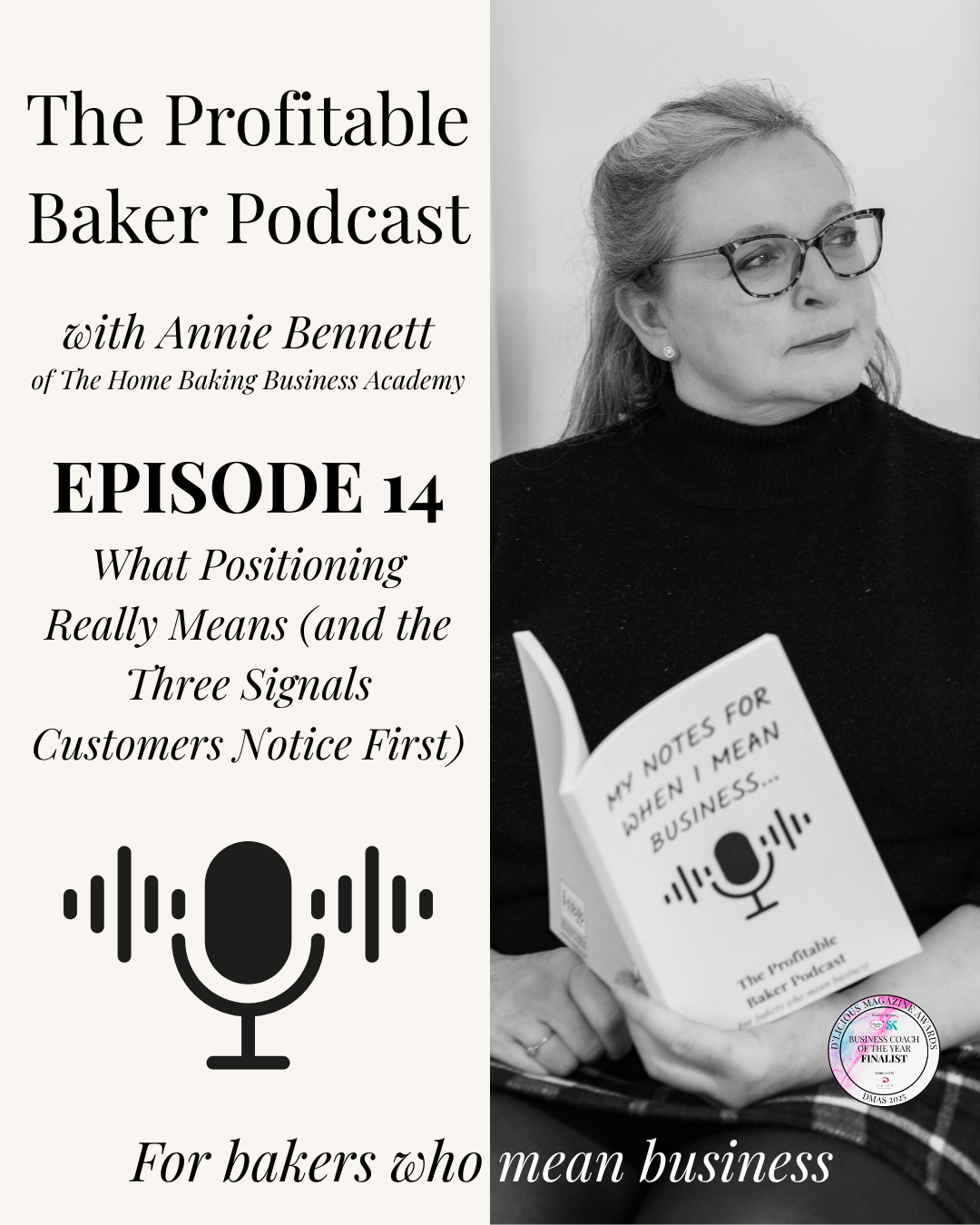

Annie ran her baking business, Leading Lady Cakes, for 10 years, following a career in primary teaching. She is now combining her teaching experience and her passion for baking to teach and support others who wish to set up for themselves.
She was a finalist in D’Licious Magazine’s Business Coach of The Year Award 2025
Find out more about the Home Baking Business Academy here;
